Santa Marta: Where Climate Advisory Opinions Met Social Movements
By Mariana Campos Vega
Background
In April 2026, hundreds of representatives from civil society, Indigenous Peoples, youth movements, academia, trade unions, and frontline communities gathered in Santa Marta, Colombia, for the First Conference for the Transitioning Away from Fossil Fuels.
The conference was designed as a space to collectively shape pathways towards a fossil-free future. However, one of its most significant outcomes was broader in scope, as it demonstrated how social movements influence public demands and policy proposals for a just transition, using recent climate advisory opinions as an advocacy tool.
Less than a year after the International Court of Justice (ICJ) issued its landmark advisory opinion on climate change, and following the Inter-American Court of Human Rights’ (IACtHR) advisory opinion on the climate emergency, references to international legal obligations appeared throughout the Santa Marta process. Across declarations and synthesis reports, participants increasingly framed the transition away from fossil fuels as a legal imperative rather than a matter of political will. To support these discussions, WYCJ published a briefing note entitled “Just Transition and Fossil Fuel Phase-Out Grounded in Legal Obligations”, which summarised the key findings of the ICJ, the IACtHR and the International Tribunal for the Law of the Sea (ITLOS), and explained their practical implications, particularly in light of the synthesis reports prepared by the governments of Colombia and the Netherlands, which consolidated civil society's demands and recommendations for the Conference.
.
The briefing note served as a key resource for the workshop “Using the Climate Advisory Opinions to Advance Fossil Fuel Phase-Out”, during which participants applied the findings of the three international courts to concrete policy scenarios. The workshop was held at the Casa de la Memoria in Santa Marta and was jointly hosted by World’s Youth for Climate Justice, Climate Action Network Latin America (CANLA), and the Heinrich Böll Stiftung Bogotá.

Participants from the “Using the Climate Advisory Opinions to Advance Fossil Fuel Phase-Out” workshop.
The Youth Declaration: a fossil fuel phase-out grounded in international law
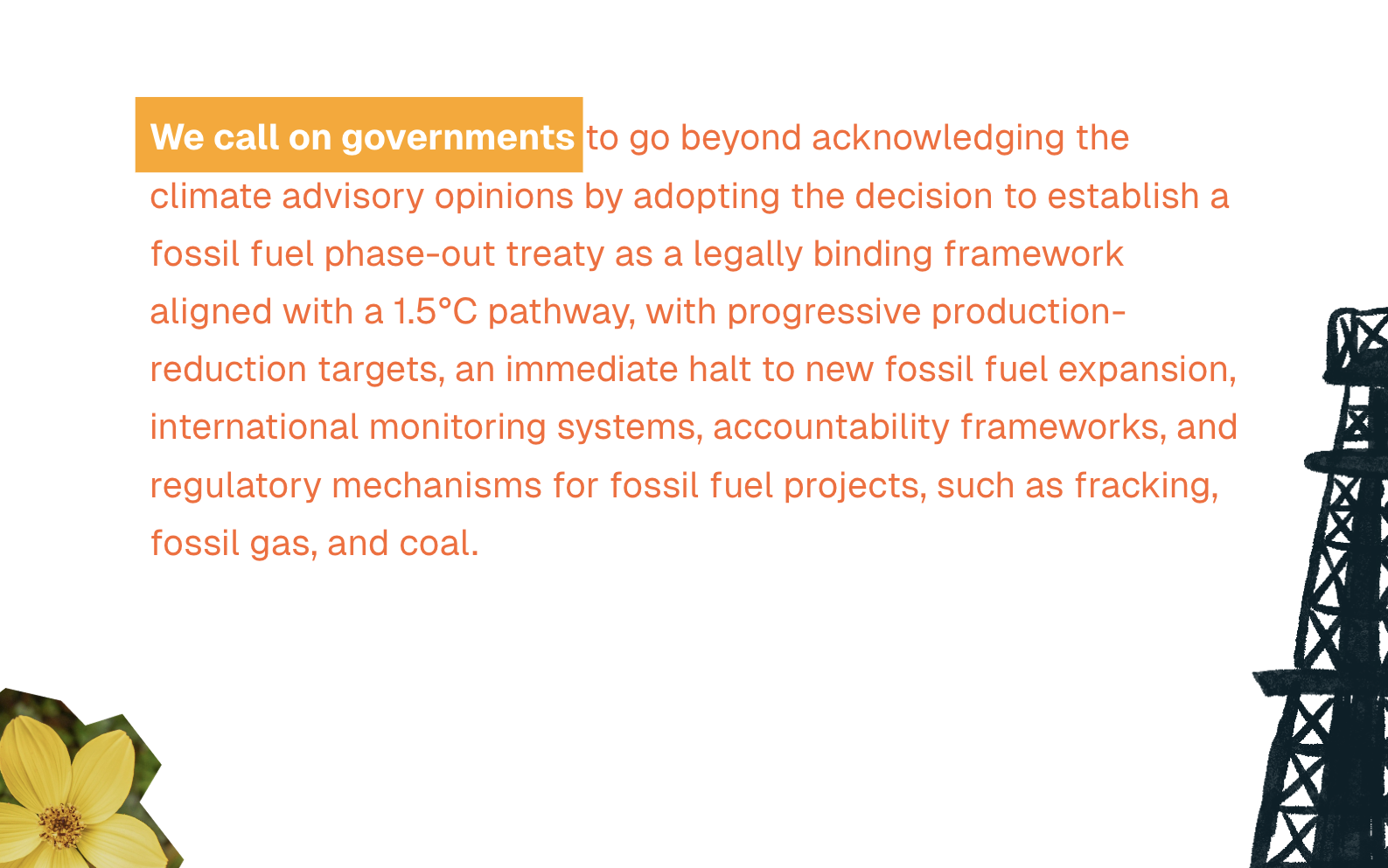
Excerpt from the Youth Statement on Just Transitions Beyond Fossil Fuels.
The Youth Statement on Just Transitions Beyond Fossil Fuels called on governments to move beyond merely acknowledging climate advisory opinions and instead translate them into concrete action, including through the adoption of a binding international instrument to phase out fossil fuels. Youth participants urged States to support a legally binding Fossil Fuel Treaty aligned with the 1.5°C primary temperature goal, including progressive production reduction targets, an immediate halt to fossil fuel expansion, accountability mechanisms, and international monitoring systems. The declaration also linked climate finance and transition finance to the obligations reaffirmed by the ICJ advisory opinion. This reflects a growing understanding among youth movements that climate justice is also about compliance with existing legal obligations.
The Children and Youth Synthesis Report: climate action as a legal duty
The Children and Youth Synthesis Report went even further. The report identifies fossil fuel dependence as a direct source of intergenerational rights violations and argues that recent developments in international law reinforce States' obligations to act. Drawing on both the ICJ Advisory Opinion and developments within the Inter-American human rights system, the report emphasizes that continued fossil fuel expansion may constitute a breach of international obligations. As a result, the transition away from fossil fuels is framed not as a discretionary policy choice, but as a “legal mandate.” This perspective also informed recommendations to prohibit new fossil fuel licenses, remove incentives that perpetuate fossil fuel dependence, and ensure meaningful participation and rights-based impact assessments in energy planning.
The People’s Declaration: Climate debt, reparations, and international cooperation
The Peoples' Declaration for a Rapid, Equitable and Just Transition for a Fossil-Free Future similarly incorporated language drawn from these recent climate advisory opinions.
The declaration reframes climate debt as more than a moral claim, recognizing its basis in legal obligations and international responsibility. It explains how emerging international legal standards increasingly support demands for reparations, international cooperation, and accountability for historical emissions. It also highlights States' duties to prevent climate harm, cooperate in good faith, regulate private actors, and support developing countries through finance, technology transfer, and capacity-building.
Importantly, the declaration calls for the operationalisation and enforcement of legal obligations related to the drivers of climate change, including fossil fuel production, use, licensing, and subsidies.
The NGOs and Academic Dialogue Synthesis Reports: A growing movement for implementation
The influence of climate advisory opinions was not limited to youth and peoples' declarations. The NGO Synthesis Report strengthened discussions around reparations, environmental restoration, and corporate accountability, while the Academic Dialogue Synthesis Report explicitly identified investor-state dispute settlement (ISDS) as a barrier to a just transition, calling for collective action in light of States' climate obligations as clarified by the ICJ.
These contributions reveal an important shift. The ICJ and IACtHR advisory opinions are no longer being discussed solely within courtrooms or legal circles. They are increasingly being adopted by social movements, civil society organizations, Indigenous Peoples, and youth advocates as tools to advance climate justice and accountability. Santa Marta showed that international law does not end with judicial pronouncements. Its real impact emerges when communities and social movements use it to shape demands for systemic change.
As preparations begin for COP31 and future climate negotiations, the challenge ahead is clear: moving from recognition of these legal obligations to their implementation. The Santa Marta Conference offered an important glimpse of what that process can look like.