Europe on Fire
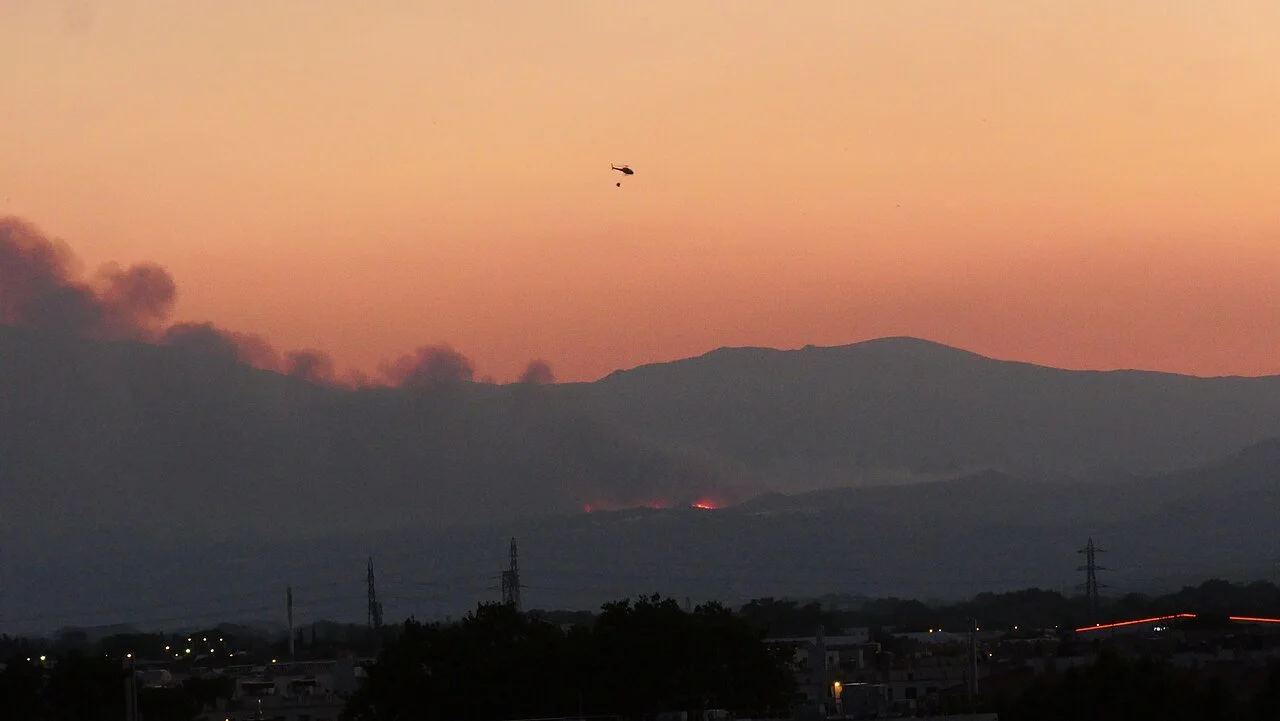
By Frenchbluesman - Own work, CC BY 4.0, https://commons.wikimedia.org/w/index.php?curid=195132010
written by Ana Laura
Introduction
This summer, those of us living in my student residence at the Cité Universitaire in Paris were woken up by a fire alarm because the smoke outside was so bad it felt like it was coming from inside. I went to the movies and the theatre's equipment overheated, so we had to leave. These are everyday inconveniences, not even half as atrocious as what people suffering and even dying from heatwaves and fires across Europe are going through, but they got me thinking about how climate change is already reshaping our everyday lives.
Europe was built for a climate that no longer exists, and this year made that impossible to ignore. In this piece, I look at how heatwaves and wildfires are already making parts of our cities unlivable, what this is costing Europe in lives, health and money, and what the law already requires States to do about it. Finally, I argue that adaptation can no longer be treated as optional, and that European leaders need to act on it now, alongside cutting emissions, at home and abroad.
From playgrounds to cities built for another climate
A while ago, I came across an analogy that helped me see things differently: when a park is not properly built, meaning little to no shade, climbing frames made of materials that radiate heat, and rubber floors that reach over 50°C, it becomes a hazard in the heat. In other words, a place meant for play and rest becomes unbearable.
Fortunately, it can easily be fixed by planting trees for shade and replacing the equipment with materials that do not absorb heat, or that reflect it instead. That same logic of designing for the heat needs to be applied at a wider level, to the architecture and infrastructure of European cities. Certainly, it is a costly plan, but investing in these measures is not just an obligation. Actually, the cost of not acting is far higher, and we have seen it take its toll this year.
Take this narrative and apply it at city level, and this is what is already happening across Europe:
France: on 22 June 2026, 845 schools and middle schools remained closed while 1,800 others adjusted their hours, and on 26 June hospitals recorded 2,089 heat-related emergency visits in a single day, the highest level since health monitoring began in 2004.
Germany: temperatures reached 41.5°C, the highest ever measured in the country, train traffic in North Rhine-Westphalia was severely disrupted, and hospital staff described working until they collapsed, yet the federal government is not granting any new funding in 2026 to help social institutions adapt.
The Netherlands: the KNMI issued a code red for heat for the first time ever, many schools closed, emergency rooms across the country were under extra pressure, and the Rotterdam-Rijnmond safety region asked mayors to cancel events because ambulance services were overstretched and hospital capacity was limited.
Spain: even the north was not spared, as Bilbao airport recorded 42.7°C on 24 June, the highest value ever measured there in June or July, and the first heatwave of the summer left 278 deaths in just six days, while doctors warned that the health system is struggling to keep up.
Public transport, museums, libraries, roads, hospitals, and even some homes are becoming unlivable because they were not built with these record-breaking temperatures in mind.
Under the UNFCCC and the Paris Agreement, States have two kinds of obligations. The first is mitigation, which means cutting greenhouse gas emissions so that climate change does not get worse, for example by setting national targets and moving away from fossil fuels. The second is adaptation, which means preparing for the effects of climate change that are already here or can no longer be avoided, such as heatwaves, droughts and wildfires, by protecting people, infrastructure and ecosystems from them. The International Court of Justice confirmed both duties in its Advisory Opinion on the Obligations of States in respect of Climate Change (ICJ AO).
Before looking at solutions, we have to look at what inaction has already cost us
Western Europe had its hottest June on record in 2026, with an average temperature of 20.74°C, 3.06°C above the 1991–2020 average, beating a record that had only just been set the year before. 2023, 2024 and 2025 were each in turn among the hottest summers Europe had ever recorded, and 2026 unfortunately upheld that pattern. More than 10,000 excess deaths were recorded across Europe in the late-June heatwave, over 9,000 of them among people 65 and older, with France alone accounting for at least 5,764.
The heat also wiped an estimated €2 billion off Europe's grain harvest, with France and Hungary responsible for nearly two-thirds of the losses. Moreover, the wildfire season showed how fast it can cascade into overwhelmed hospitals, strained power grids, and billions in economic losses. Let us not forget water shortages and the long-term consequences of these wildfires for public health. People's security is also at risk: in July, a fire in Gironde burned 42,000 hectares, destroyed 240 homes, came within 15 kilometres of Bordeaux and forced more than 220,000 people to evacuate.
This has to be addressed, and treating it as a cost to avoid turns out to be the more expensive choice. There is no other way around it: natural assets are what prosperity, and survival, actually depend on. The Earth is our home, and these are the consequences of our own actions. As much as we would like to keep pushing mitigation as the way to stop climate change, the consequences are already here, and we need to adapt too. In other words, climate resilience has to be considered at every step of planning. Left unaddressed, this exposes Europe's people, infrastructure and sovereignty to a threat that, unlike conventional warfare, respects no borders. A lack of preparedness becomes a danger in itself.
What the right measures have in common is that they protect people before the heat arrives, not after. This could look like resilient energy grids, cooling shelters, and a faster, better-resourced EU Civil Protection Mechanism, strategic priorities in line with the kind of measures the ICJ AO says can meet States' adaptation obligations, such as early warning systems and resilience-enhancing infrastructure (ICJ AO, para. 258).
The WHO's own recommendations for European cities point in the same direction: expanding tree canopy, replacing concrete with permeable, heat-reflective surfaces, the same "sponge-city" logic as the playground fix from earlier, and building out heat-health early warning systems that map vulnerable people and reach them directly during a heatwave. These are only a few examples, not a complete list, but they show what preparing ahead of time can look like.
Adapting to this new reality is not optional
States have binding obligations on adaptation, and the ICJ has now said so explicitly. The advisory opinion clarifies the binding duties under the UNFCCC and the Paris Agreement to plan for climate impacts through adaptation programmes, vulnerability assessment, and resilience building, and it names "managing land to reduce wildfire risk" as one of the measures that can meet a State's adaptation obligations (ICJ AO, para. 258). The Paris Agreement also calls on States to conserve and enhance carbon sinks, "including forests" (Article 5), reinforcing obligations that were already binding under the UNFCCC (ICJ AO, para. 232).
Wildfires are immensely destructive both in the short term and in the long term. They release stored carbon and shrink future absorption capacity, a feedback loop embedded in the law's own logic, which is why the underlying obligation to protect sinks, first made binding under the UNFCCC (Article 4, paragraph 1(d), "shall"), carries real legal weight rather than staying purely aspirational (ICJ AO, para. 202).
Every one of Europe's 32 EEA member countries now has a national adaptation policy on paper, but implementation tells a different story: financing stays uncertain, monitoring of whether measures actually work remains patchy, and small municipalities in particular are left without the resources to act.
The European Commission's own estimate puts the cost of adequate adaptation investment in transport, agriculture and energy at €70 billion a year through 2050, yet EU countries currently spend only around €29 billion a year, while climate and weather extremes have already caused €822 billion in losses in the EU since 1980. Clearly, the price of doing nothing is one that has to be considered.
Europe's responsibility does not stop at its borders either. Take the European banks still bankrolling forest destruction thousands of kilometres from home, including in Latin America: since the Paris Agreement, EU banks have made $3.5 billion in income from financing companies involved in deforestation, led by BNP Paribas and Rabobank. These banks should be requiring their clients to adopt and enforce real No Deforestation, No Peat, No Exploitation (NDPE) policies, ones that explicitly prohibit the use of fire, verifying those standards hold up throughout supply chains, backing fire prevention and local response efforts, and cutting financial ties with companies that keep failing to meet them, not extending new loans or refinancing to companies already found legally responsible for forest and peatland fires.
This is a call for European leaders: Europe cannot afford to wait for another summer
If this is going to be called a climate crisis, it needs to be treated like one: urgent action, now, on adaptation as much as mitigation, so next summer does not become one more entry in this streak of catastrophic summers. That means phasing out fossil fuels and transforming Europe into a clean energy hub, not chasing false solutions like an over-reliance on carbon capture and storage.
But it also means confronting the consequences of decades of inaction. European people are owed protection from heat and drought: food sovereignty, sustainable water management, adaptation infrastructure, and clean energy cooling systems, prioritised over data centres, pesticide conglomerates, and short-term profit, before the social, economic and environmental costs already building over our heads come crashing down.
